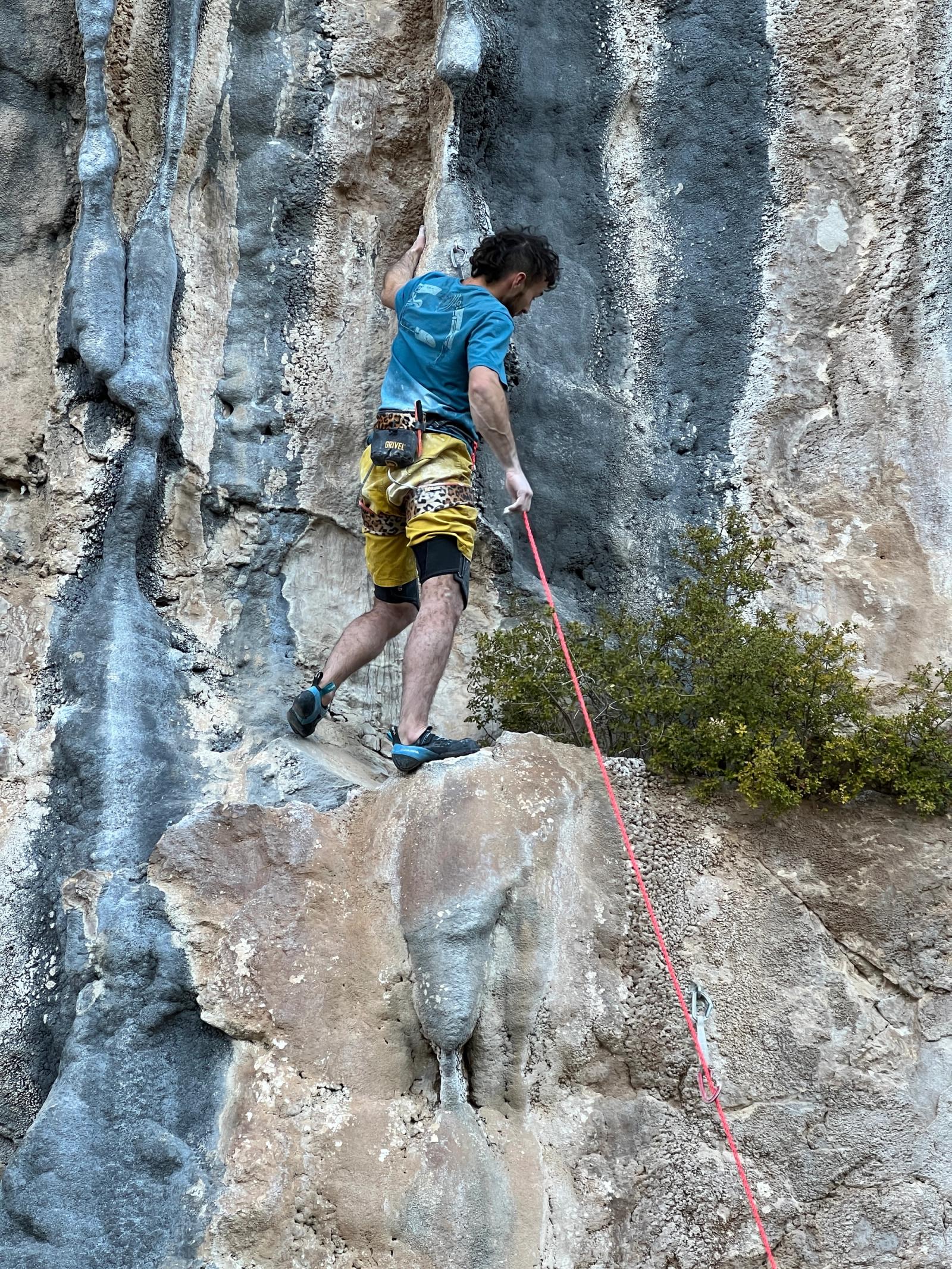
Recovery for Climbers: How Sleep, Stress, and Lifestyle Shape Your Climbing
Sleep, stress, alcohol, and nutrition directly affect your climbing. My take on the lifestyle factors that quietly build or destroy your progress on the wall.
The things outside the wall that quietly build or bury everything you are working towards.
I'm sure most of you have felt it. A session where nothing works, moves you have done a hundred times feel impossible, your skin goes after twenty minutes, your head is somewhere else entirely… The easy answer is to blame training, or rest days, or the stars not aligned.
But often the real reason has nothing to do with any of that.
Your body doesn't separate your life from training. It never has. Your fingers don't understand whether stress comes from a hard fingerboard session, money issues, poor sleep, emotional exhaustion, a tough day at work, or a couple of beers too many the night before. Stress is stress. And your body experiences it all as load. Which is why sometimes the most honest thing a coach can say is: the problem isn't your training programme.
I think many climbers massively underestimate how much external factors influence climbing progression and recovery. They look constantly for the perfect fingerboard session or the best power endurance exercises, while neglecting sleep and living constantly overstimulated. In the meantime, recovery quietly fades.
This article is based on my interpretation of the research I have looked at around recovery, stress, sleep, and athletic performance, mixed with my own coaching perspective and practical experience working with climbers. I believe science gives us a solid direction, but climbing is still very personal, and the best understanding usually comes from combining evidence with real life experience and observation.
Why recovery matters for climbers
Recovery is often misunderstood as doing nothing. Resting.
But biologically, recovery is incredibly active. Adaptation happens after training, not during.
Training is just the stimulus. The body doesn't adapt during a hard session on the wall, it adapts while you sleep, while you eat, while you step away from it. Tissue repairs, energy is restored, you retain skill... The nervous system assesses and processes everything it went through and quietly decides what to do with it.
This is why two case scenarios with the exact same training plan can lead to completely different results. In one you sleep well, eat properly, manage stress reasonably, and adapt positively. In the other you accumulate fatigue faster than you can recover from it.
The difference isn't always visible from the outside. But the body keeps notes of it all.
Physical readiness also influences how much stress the body can tolerate in the first place. General strength training, tissue resilience, and overall physical capacity can affect how sustainable climbing training becomes over time. I go deeper into that in Why General Strength Training Matters for Climbers.
Sleep and climbing performance
Sleep is one of the few recovery tools that consistently affects almost every aspect of performance and climbing recovery.
- Strength output
- Reaction time
- Motor learning
- Mood
- Hormonal regulation
- Tissue repair
- Pain perception
- Decision making
And climbing pretty much depends on all of those things.
Research consistently shows that lack of sleep negatively impacts physical performance and recovery capacity in athletes. Another systematic review examining sleep interventions found that improving sleep quality was associated with improvements in recovery, mood, and aspects of physical and cognitive performance.
I think climbers often notice the obvious effects first:
- Feeling weaker
- Poor coordination
- Reduced motivation
- Struggling to commit
- Sessions feeling unusually hard
- Skin feeling sensitive
- Recovering poorly between attempts
- Increased irrational fear
But there are also subtler consequences. Lack of sleep can change perception. Moves feel harder, fear turns louder, frustration takes over you, decision making becomes erratic, precision fades. And climbing is such a coordination demanding sport that even small reductions in cognitive performance matter a lot.
You might get away with poor sleep in sports where execution is simpler and more predictable, but climbing is not predictable. Every climb is physically demanding, and especially when onsighting a route you will have to problem solve while getting more and more pumped. Sleep deprivation doesn't just tax the body. It taxes the part of you that has to think, read, decide, and commit, all while getting pumped.
How stress affects climbing recovery
Something I come back to consistently with the climbers I work with: your life stress adds up.
The body does not really separate psychological stress from physical stress. Both draw from the same pool. Both demand recovery. Both influence how well you adapt to training over time.
Research across elite sport shows a strong relationship between high psychological stress and reduced recovery capacity. And climbing already is a really emotional sport. Fear, falling, pressure, expectation, identity, performance anxiety. That is a significant load before the rest of life even enters the picture.
Then we have financial stress, poor sleep, complicated relationships, work pressure, travel, under-eating, emotional exhaustion, and eventually the system stops adapting efficiently. You still fit all the sessions, and the effort is genuine, but the feedback slows down simply because the body is dealing with too much at once.
This is why sometimes the right move is not to train harder. Sometimes it might be to reduce load temporarily. Not because you or the climbers you work with lack discipline or commitment, but because the system as a whole is overwhelmed, and pushing into it will only dig the hole deeper and deeper.
I always think of fatigue as information, not a weakness, not laziness. Information.
Alcohol and climbing recovery
Nobody loves this part of the conversation. I am not suggesting that climbers should completely avoid alcohol. Life matters too, and in some cases you may benefit more from having a beer after a really stressful day and enjoying time with good friends than from staying home trying to do everything by the book. Context matters.
But alcohol does affect athletic recovery physiology.
Research examining alcohol consumption after exercise has shown negative effects on muscle recovery, hormonal balance, hydration, sleep quality, and muscle protein synthesis. How much depends heavily on dose and timing. A couple of drinks every now and then is very different from regular drinking around big climbing days.
Even moderate alcohol intake can disrupt sleep quality, which indirectly affects recovery. And that matters because recovery is cumulative. A single poor night rarely destroys progress. Repeated compromised recovery probably will.
But here is something I think gets missed in these conversations. For many climbers, approaching life in a better mood will do more for recovery than a really strict lifestyle. If you genuinely don't enjoy drinking, perfect, don't drink. But if you do enjoy a beer or two and you are sacrificing good times outside of an already stressful routine, that trade-off might actually be hurting your recovery more than the drinks themselves.
I have been there. There was a time where I really enjoyed not drinking at all, to the point where extreme discipline was what drove me. That is not where I am anymore, and when I try to force it I tend to sleep worse, feel more insecure, get a little flat. A beautiful sunset with a beer in hand, good friends, some music, that gets me into a much better headspace than trying to recover by the book in a place where I simply can't seem to find comfort right now.
To be clear, I am not saying it is okay to wake up feeling hungover every other day. I am saying the perfect balance lives somewhere in a fair compromise. Not perfection. Not chaos. Somewhere honest in between.
Not about perfection. About being honest with yourself about the trade-offs. Mind and body work best when they are working together, not against each other.
Nutrition and recovery for climbers
You cannot recover from what you cannot fuel.
Climbing culture sometimes glorifies being lighter without fully appreciating the cost of chronic under-fuelling. And I want to be clear about something before going further: I am not a nutritionist, and I am not here to tell anyone what the perfect diet looks like. I have strong opinions on this, but I hold them with humility.
Low energy availability can impair recovery, reduce strength adaptations, negatively affect hormonal function, increase fatigue, and potentially increase injury risk. And the difficult part is that under-fuelling does not always feel dramatic initially. Sometimes it simply feels like:
- Flat sessions
- Plateaued progress
- Mood instability
- Persistent soreness
- Poor recovery between attempts
- Reduced motivation
- Small injuries that never fully settle
Many climbers accidentally spend months slightly under-recovered because they normalise low energy levels as just part of training hard. But adaptation requires resources. The body cannot build effectively while constantly managing an energy deficit.
I like to think about food in colours. The stronger the ingredients, the more time I spend preparing a meal, the brighter the colour I use to mark it on my calendar. A vibrant, elaborated meal gets a deep rich colour. A rushed, low effort, low nutrient meal gets a pale shallow one. At the end of the month I want to look at a calendar full of bright colours. That represents my energy, my mood, my recovery, the quality of what I have put inside me.
It would be a dream to train for hours every day and then fuel in five minutes as if you were filling up a car. To me that is disrespecting myself. Investing time in my meals makes me feel good about myself. It boosts confidence. It reinforces the belief that I am doing things right. You don't need to be a full time cook to do things well, and most of this is relative and deeply contextual.
I am not sure there is a perfect diet, and I am not even sure the one I follow is objectively right. But I eat well, I eat out, I enjoy it, and I love eating almost anything. My number one rule, borrowed loosely from Michael Pollan: Eat whatever you want, whenever you want, not too much, mostly green.
We live in an era where the pressure to be light is a danger to the climber themselves and to the legacy it leaves behind. As a climbing community we need to talk about this more openly and more honestly. I follow a zero tolerance policy for any narrative that glorifies restriction or extreme leanness in climbers, and I always try to get professionals involved if I suspect things are going out of hand. Our community should do the same. Listen to them. Work with them. Do not ignore what can become a very serious and life threatening issue.
This is a topic I find genuinely fascinating and one I want to explore properly at some point. I am hoping to turn it into an interview article with a nutrition professional who works with athletes, so we can have a real and informed conversation about it. Watch this space.
Recovery is individual
Two climbers can train identically but will tolerate it completely differently.
Some recover quickly. Some slowly. Some handle high volume well. Others break down under it. Blindly copying an elite climber's programme goes wrong for exactly this reason. You are not just copying their sessions. You are unknowingly trying to copy their recovery capacity, genetics, training history, sleep habits, lifestyle, support systems… The whole invisible structure that makes that level of work sustainable for them.
Often, climbers compare their own exhausted bodies to somebody whose entire life is organised around performance. And that comparison is rarely fair or useful.
I have worked with climbers at very different levels and one of the most humbling things I have learned is that the climber in front of you is always a completely unique equation. Same age, same grade, same programme, completely different human being underneath. Different stress tolerance, different life situation, different relationship with their own body, different history. You cannot just swap one for the other and expect the same outcome.
Understanding yourself honestly, without comparison, is one of the most underrated skills in climbing development. And one of the hardest. We live in a world that makes comparison almost unavoidable. Social media shows you the highlight reel of someone else's training and none of the context behind it. Once again, context matters enormously.
Sometimes the best decision is rest
Hard for ambitious climbers to sit with. Rest feels unproductive. Stepping back feels like falling behind.
But rest is productive. Recovery is where adaptation lives. The ability to rest intelligently, to read what your body is telling you and respond honestly rather than through ego, is part of what training maturity actually looks like.
And training maturity takes time. Most climbers learn this the hard way, myself included. There is something about ambition that makes rest feel like a moral failure. Like if you are not suffering you are not serious. I have felt that. I have also felt the other side of it, the session that clicks because everything was right going into it, the project that finally goes because the body was actually ready.
Some of the best sessions happen because recovery was respected beforehand. Some of the worst and even some injuries, happen because it wasn't.
And not every ache or discomfort means stop completely. The body is more resilient than we sometimes give it credit for. Learning to read it, track it, and work around things carefully and intelligently is part of the process. What matters is developing the awareness to distinguish between something that can be managed and something that genuinely needs action. That line is not always obvious, and when in doubt I always recommend getting a professional involved early rather than late.
You cannot force adaptation indefinitely. At some point the body starts negotiating back. The question is whether you are listening before it hits you in the face.
Final thoughts
Climbing performance is not only built on the wall.
It is built in sleep. In how you carry the weight of your life. In whether you eat enough. In the small daily habits that either support recovery or quietly compromise it. It is in your food. In the moments you choose rest without guilt. In the honesty it takes to admit that sometimes the problem has nothing to do with your training plan.
I have worked with climbers who were doing everything right on paper and going nowhere. And I have worked with climbers who trained less, slept more, ate well, managed their stress reasonably, and quietly overtook people who were working twice as hard. The difference was rarely talent. It was the environment. The invisible stuff. The effect their lifestyle had on their climbing.
Science backs this up. Sleep, nutrition, stress, recovery, they are not soft variables. They are physiological realities that determine how much of your training actually stays. You can have the best programme in the world and the right intentions and the deepest motivation, and still spin your wheels if the environment around the training is working against you.
But this is also one of the most hopeful things I know about climbing development. Because you can always improve your environment. You can sleep better. You can eat with more intention. You can learn to read fatigue as information rather than weakness. You can build the awareness to know when to push and when to pull back. None of that requires a new programme or a better coach or a more expensive training tool. It just requires honesty and a willingness to look at the whole picture.
Sometimes improving as a climber has less to do with finding a better programme and more to do with creating an environment where your body can actually do what you are asking of it.
Because the body is always listening. Not only to training, but to everything…
And the climbers who improve most over time are rarely the ones who trained hardest in any given month. They are the ones who built something sustainable, protected it, kept showing up, and had the maturity to understand that recovery is the key to progress, the key to growth.
Frequently asked questions
Does lack of sleep affect climbing performance? Yes, and probably more than most climbers expect. Poor sleep can negatively affect strength, coordination, reaction time, recovery, decision-making, and injury risk. But beyond the physical, sleep deprivation changes perception. Moves feel harder than they are, fear gets louder, commitment fades. In a sport that demands both physical output and mental clarity at the same time, that combination is particularly expensive.
Can stress reduce climbing performance? Yes. High psychological stress can impair recovery, increase fatigue, reduce adaptation, and negatively affect climbing performance. And the tricky part is that stress doesn't announce itself as a training problem. It just shows up as flat sessions, slow progress, and a body that isn't responding the way it should. Managing stress is not a lifestyle luxury. For a climber who wants to improve consistently, it is part of the training.
Does alcohol affect climbing recovery? Yes it will, and the most relevant impact is on sleep. Even moderate alcohol intake disrupts sleep quality, which is where most of your recovery actually happens. Beyond that, research points to negative effects on muscle recovery, hydration, hormonal balance, and muscle protein synthesis. Context and dose matter enormously, but drinking regularly around hard training days is worth taking seriously.
Why is recovery so important for climbers? Because adaptation does not happen during training, it happens after. Training is just the signal. Recovery is where the body repairs tissue, consolidates motor patterns, regulates hormones, and builds the capacity to handle future load. Compromise it regularly and training stops returning what you are putting in. You can be the most dedicated climber in the room and still go nowhere if the environment around your training isn't allowing any of it to land.
Eder
Related: Why General Strength Training Matters for Climbers
References
Fullagar, H. H. K., et al. Sleep and Athletic Performance: The Effects of Sleep Loss on Exercise Performance, and Physiological and Cognitive Responses to Exercise. Sports Medicine (2015).
Walsh, N. P., et al. Sleep and the Athlete: Narrative Review and 2021 Expert Consensus Recommendations. British Journal of Sports Medicine (2021).
Dupuy, O., et al. An Evidence-Based Approach for Choosing Post-Exercise Recovery Techniques to Reduce Markers of Muscle Damage, Soreness, Fatigue, and Inflammation. Frontiers in Physiology (2018).
Barnes, M. J. Alcohol: Impact on Sports Performance and Recovery in Male Athletes. Sports Medicine (2014).
Parr, E. B., et al. Alcohol Ingestion Impairs Maximal Post-Exercise Rates of Myofibrillar Protein Synthesis Following a Single Bout of Concurrent Training. PLOS ONE (2014).
Mountjoy, M., et al. IOC Consensus Statement on Relative Energy Deficiency in Sport. British Journal of Sports Medicine (2018).
Charest, J., and Grandner, M. A. Sleep and Athletic Performance: Impacts on Physical Performance, Mental Performance, Injury Risk and Recovery, and Mental Health. Sleep Medicine Clinics 15(1): 41-57 (2020).
Kellmann, M., et al. Recovery and Performance in Sport: Consensus Statement. International Journal of Sports Physiology and Performance 13(2): 240-245 (2018).